Sam Walters.
Sam Walters, GM of Consulting, at Cubery.
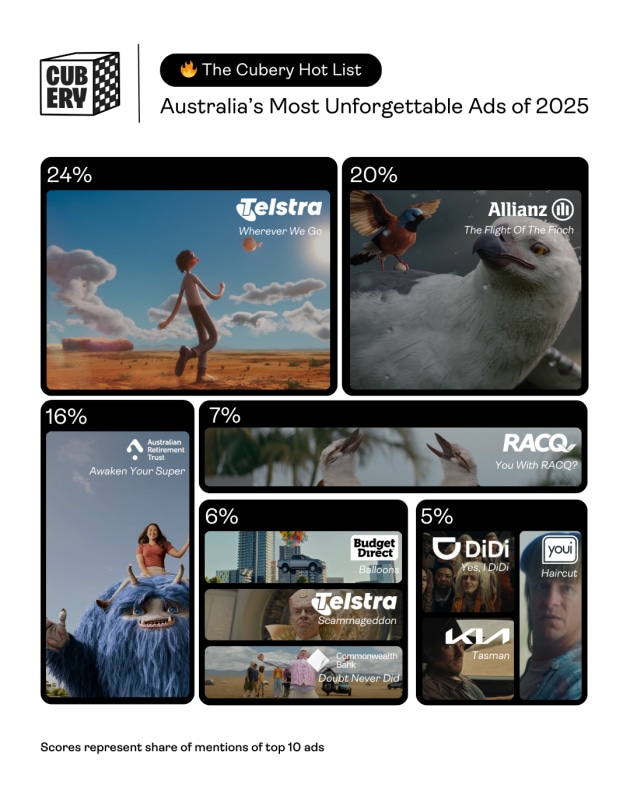
Every quarter Cubery releases its Hot List of Australia’s most unforgettable ads. This isn’t a popularity ranking nor is it necessarily a measure of pure creative effectiveness. Rather, it simply reflects which ads have lodged themselves most firmly in people’s memories.
And the latest list follows a familiar pattern, with financial services brands and telcos continuing to dominate the charts (okay, fine, Telstra—not all telcos!) But it’s encouraging to see these brands pushing the boundaries in what many would describe as traditionally conservative categories. But what I find equally interesting—and perhaps more revealing— than who appears on the list, is who does not.
Because take a look, there is very little food and beverage advertising. No alcohol. No beer ads at all.
This absence is striking, because when people think about the most memorable advertising of all time, they rarely start with banks or telcos. They think of the likes of Guinness, Carlton Draft, Victoria Bitter, Coke, Pepsi, and Snickers. Categories that didn’t just advertise, but shaped popular culture. And, in many ways, taught the industry about the fundamental
ingredients for generating fame.
It got me wondering, where did all the good beer ads go?
Beer was once the blueprint for memorability
For decades, beer advertising was where creative ambition went to stretch its legs. It was loud, funny, strange, and sometimes indulgent. But more often than not, culturally resonant.
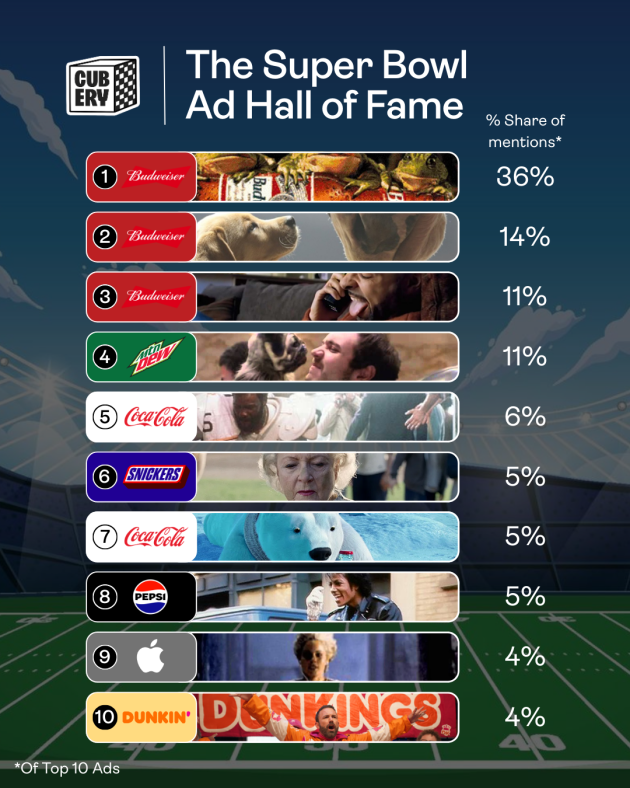
You need only look at Cubery’s most memorable Super Bowl ads of all time to see that in action. Particularly Budweiser, who still dominates consumer recall in the U.S. over two decades later with their Super Bowl hits of the 90s and 2000s.
Guinness told surreal, visually rich stories that made people want to watch time and time again. Carlton Draft leant into broad-appeal comedy and characters that felt bigger than the product itself, resulting in people genuinely wanting to talk about and share these ads with friends. VB embraced exaggerated masculinity to the point of self-parody. These ads didn’t
just deliver a message; they, first and foremost, sought to entertain.
And perhaps most importantly they gave people a reason to care. Even if you don’t drink beer you still remember the advertising for its playfulness and bravery.
Which is precisely why their current absence from a list of unforgettable ads feels so jarring.
Surely, beer, of all categories, should still be overrepresented?
Regulation changed the rules, not the brief
It would be naive to ignore the role of regulation, with today’s alcohol advertising operating under far greater scrutiny than in decades gone by. The category can no longer lean on many of the social or aspirational cues that once powered its most famous work.
Yes, all of that puts beer advertising somewhat behind the eight ball. But that’s the exact circumstances advertisers in the category have traditionally thrived in.
From fame to safety
Would it be too much to suggest that there has been a shift in the category’s ambition?
There certainly seems to have been a pivot away from the single-minded pursuit of being unforgettable.
Many beer ads today (and alcohol ads more broadly) feel designed to offend no one, amuse briefly, and then disappear
quietly. Humor, where it exists, is often more toned down than it’s been in the past. And there’s certainly less boldness in the delivery.
This shift isn’t unique to alcohol. Zooming out, food and drink advertising more broadly has become more restrained. But it feels especially evident in the beer category where it had once been at the pinnacle.
And therein lies both the problem and the opportunity; entertainment is not simply a nice-to-have. When brands stop trying to be entertaining, memorability tends to vanish with it.
The Cubery Hot List perfectly encapsulates this phenomenon.
Who let the “boring” categories craft elaborate stories?
What makes the dominance of telcos and financial services more interesting isn’t just that they are winning, but it’s how they’re going about it. You need only look at the top 10 ads to see the clear emphasis on storytelling over messaging, using humour, characters, and relatable situations rather than neatly packaged propositions.
Many of these campaigns are underpinned by ideas that are a little odd or over-the-top.
Australian Retirement Trust’s big blue monster is a good example. It exists purely to dramatize an idea in a way that’s visually distinctive, slightly bizarre, but ultimately difficult to ignore.
That approach taps into something beer advertising once understood very well: people remember stories, and deploying a touch of absurdity can often be just the tonic needed for making an ad stick.
These categories aren’t significantly less constrained than alcohol; they have simply become more willing to use humour and storytelling as a way to navigate these limitations, rather than retreating to safety.
The uncomfortable question
So, where have all the good beer ads gone?
They haven’t disappeared entirely; many have just taken a more restrained approach over striving toward unforgettable.
Regulation has made the task harder, yes, but strategy has determined whether the fire still exists in the belly to overcome these obstacles. And when categories that once defined how brands become famous step away from that ambition, the industry loses more than a few iconic campaigns: it loses its barometer for what creativity can and should look like.