


Bonnie Dodemaide.
Bonnie Dodemaide, Head of Digital, iProspect, a dentsu company.
I love stories. You are instantly drawn in, captivated by the subject and eager to know what happens next. Stories live everywhere, in the words we read, the voices we hear, and the images that move across a screen.
Growing up I would get caught up in another reality through books and movies from Goosebumps to The Matrix, Mean Girls and Harry Potter. While the characters and the plots shifted as I grew up, one factor remained consistent: there was nothing else in that moment, just me, the story, and the emotion it evoked.
That emotional pull is exactly what makes audio storytelling so powerful.
It’s not just about hearing a voice or a song, it’s about how that voice or tune makes you feel, what it brings back, and how it stays with you.
Certain albums take me straight back to moments in my life like MGMT - Oracular Spectacular and the feeling of travelling. Some podcasts, like Do You Hear What I Hear? from This American Life, have stuck with me for years. I still share them, because the story never really leaves you.
But audio’s power goes beyond personal connection - yet as a platform for brands, only 46% of marketers perceive radio as effective. However, audio is no longer just radio, it’s a dynamic, multi-format platform that reaches audiences across podcasts, streaming, smart speakers, and connected cars. Marketers who overlook this are missing a powerful opportunity to connect with highly engaged, screenless consumers.
Audio has evolved, shaped by technology and culture into one of the most dynamic and trusted formats in today’s media landscape. From the music that soundtracks our lives to the podcasts we return to and share, audio continues to deepen its role in how we connect, remember, and engage.
This evolution has been decades in the making.
Guardian journalist Ben Hammersley coined the term podcasting in an article titled Audible Revolution, blending iPod and broadcast to describe downloadable audio shows. What began as a casual suggestion quickly grew into a cultural movement, and by 2005, “podcast” was named the New Oxford American Dictionary Word of the Year, cementing its place in digital media and the modern day vernacular.
Music streaming evolved from early internet broadcasts and file-sharing experiments of the 1990s, such as Napster, which allowed peer-to-peer MP3 sharing. I have memories of loading my iPod up with Spice Girls, Backstreet Boys, Ace of Base, Hanson, Grinspoon and Regurgitator - anything 90s I could grab from Napster. These innovations paved the way for on-demand platforms like Spotify and Apple Music. By 2016, streaming in Australia had overtaken physical sales, reflecting the surge in accessible, on-demand audio consumption alongside the growth of podcasting.
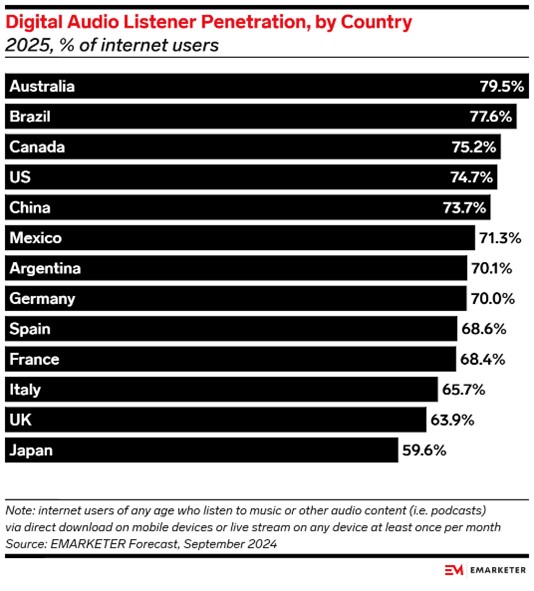
Today, Australia leads the world in digital audio consumption, with 79.5% of Australian internet users listening monthly. Yet despite this massive audience, digital audio advertising accounts for only 1.9% of total Australian internet ad spend. This stark contrast underscores a significant opportunity for brands to invest in digital audio and better align advertising with consumer behaviour.
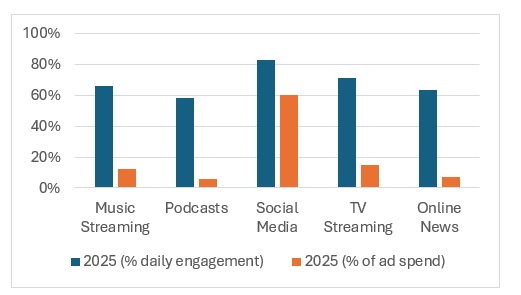
As trust in social media declines, brands are looking for safer, more meaningful ways to connect. Even video platforms like YouTube, while powerful and popular, are increasingly saturated, with $4.5 billion spent on video advertising in Australia in 2024 alone, standing out is harder than ever.
That’s where digital audio comes in. Radio and podcasts are now seen as some of the most ethical ways Australians consume content, offering trust and accountability. Audio feels like a breath of fresh air. It is more curated, more controlled, and less chaotic. A compelling place to show up for brands.
Audio isn’t just background noise, it’s a companion. It creates space for brands to connect with people in ways that feel personal, relevant, and unobtrusive. Unlike visual formats that fight for attention, audio invites focus. Whether someone’s deep into a podcast or lost in a playlist, they’re often fully engaged. In these moments, brands aren’t just heard, they’re felt.
That’s why audio advertising delivers standout results. Podcast ads drive 4.8× greater brand recall than display and 2.3× more than TV, while host-read ads achieve a 76% recall rate. AM/FM radio delivers $2 ROI for every dollar invested. And, 57% of ad-supported streaming listeners say they remember ads most in streaming environments, proof that when audio connects, it sticks.
Audio doesn’t just build awareness it influences buying decisions. 62% of podcast listeners are more likely to consider purchasing advertised products, and there’s a 58% lift in purchase intent among regular podcast listeners. Plus, 69% of ad-supported streamers are more likely to buy from brands they engage with across multiple devices. Investment on radio can double campaign effectiveness.
Agencies are increasing investment because audio delivers scale, precision, emotional impact and it drives action. iProspect’s strategic approach to audio has been instrumental in delivering this level of performance. Recent campaigns have shown that audio ads can achieve up to 41% prompted brand recall, with unprompted recall also reaching 17% in podcast environments, proving audio builds lasting brand connections through trusted content. Audio is also delivering tangible results, footfall measurement revealed a 16% drop in cost per store visit when our team leveraged The Trade Desk’s Kokai platform and Spotify inventory, we optimised toward footfall, enabling the DSP to learn and improve performance as more data flowed in.
Audio blends trust, intimacy, and engagement to create meaningful connections, making it one of the most effective and underutilised tools in a brand’s media mix.
So, the question for marketers is, will you invest your media dollars where your audience is truly listening?