


Nine Entertainment, in an update to investors, has pitched its “under-appreciated” publishing unit.
The assets, perhaps suffering from a long shadow of shrinking print, have reached what Nine calls a “digital inflexion” point.
And Nine believes that the market doesn’t factor this into valuations.
Market analysts generally like Nine for its spread of assets, across free-to-air television, streaming, audio and publishing, and its increasing revenue from digital operations.
“The fundamentals are solid, and the transition to a digital-centric model is working,” said Brian Han at Morningstar, in a note to clients in August.
He was focusing on Nine’s cash bonanza from the sale of its Domain stake and the possibility of a strategic acquisition.
“Nine should stay the course and better monetise its undervalued assets,” Han said.
Nine told its AGM earlier this month that it is focused on cost initiatives, as well as structural objectives.
“Nine’s exposure to both digital and subscription markets is helping to offset the advertising market softness, and furthers our strategic opportunity of using the power of the Nine group to deepen our connection with audiences and advertisers by harnessing our unique data and premium content to drive growth."
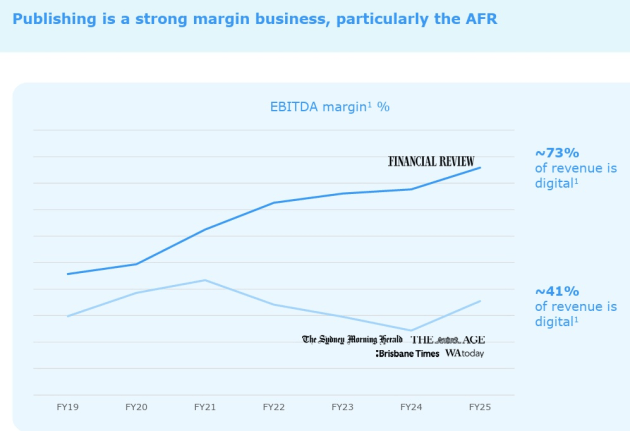
At the investor update, Nine called out the AFR, the national business news and finance operation, which has three quarters of its revenue coming from subscriptions.
Other titles, such as the SMH, The Age, Brisbane Times and WAtoday, have about 41% digital revenue.
And print now accounts for less than 25% of overall publishing revenue.
Nine argues that the AFR performs well when compared to similar titles in the US.
Looking at the percentage of circulation/subscription revenue, the AFR comes in at 84%, the New York Times at 73% and Dow Jones 74%.
The AFR has been posting average revenue growth of 6% over each of the last six years, with strength in digital subscription and events.
Nine is positioning the publishing side as trusted, against a “proliferation of derivative AI-generated content”.
Among system improvements at Nine are AI content search personalised content recommendations.
Tory Maguire, Nine’s managing director, publishing, said the next three to five years will be transformative, presenting “significant opportunity”
The latest numbers show Nine Publishing in the year to June with revenue down 6% to $526 million, with drag from withdrawn revenue from Meta. There could be some upside later on this.
Digital subscription revenue growth, coupled with a disciplined cost performance, offset much of the impact of the Meta hole and softer advertising markets.
Market analysts who attended the investor update generally agreed with Nine on the assessment of publishing.
Independent investment and advisory group Jarden analysts are doing further work on the data points and strategies aimed at Nine exploiting its unique data and premium content to drive growth.
“The key takeaway from our perspective was the emphasis that Nine's Publishing assets have reached a digital inflection point and remain under-appreciated by the market,” the analysts said in a note to clients.
“This is core to our thesis on NEC (Nine), with publishing approximately half of our SOTP (sum of the parts) valuation.
“In particular, NEC highlighted the strength of the AFR with 73% of revenue being digital vs 41% for the metro mastheads (e.g. SMH, Age), with its digital subscription revenues having grown at a 16% CAGR over the past six years.”
The analysts said the comparisons with Dow Jones and the New York Times should be treated with caution given the different business mixes, print contributions and accounting treatments.
At investment bank UBS analysts said Nine focused on key drivers including better monetisation of content between TV and Streaming, potential value unlock in digital publishing and digitisation of archive news.
“Post the sale of Domain, NEC remains focused on its existing Digital assets, particularly streaming (Stan and 9Now) and digital publishing.
“Whilst we see growth opportunity from these assets, we remain neutral on NEC given broadcast remains a large proportion of group earnings (40%), with NEC calling out weaker spend from retail and government categories.
The analysts said digital growth is now exceeding print declines and the AFR's metrics are strong.
“However, we see it likely the market will be waiting for the broader Digital and Publishing business (including metro mastheads) to deliver sustainable double-digit EBITDA growth,” they said.
Slides from the Nine's investor update:

Have something to say on this? Share your views in the comments section below. Or if you have a news story or tip-off, drop us a line at adnews@yaffa.com.au
Sign up to the AdNews newsletter, like us on Facebook or follow us on Twitter for breaking stories and campaigns throughout the day.