


Credit: Julien Tromeur via Unsplash
The death of search has been greatly underestimated but rather than disappearing it has transformed. It is undead, reanimated into a strange creature.
The switch to AI search has already started to eat into organic traffic referrals online in Australia.
Data from digital market intelligence company Similarweb shows a more than 5% drop on news websites in Australia and a lot more to come. Some sites, such as ABC news did well.
It’s a darker story in the US where AI search has been around longer, adding more dips to a trend.
High organic referral traffic sites such as the Washington Post and the HuffPost are down by up to half.
“For a lot of people, there's fear, there's confusion, there's frustration and anger, amongst publishers in particular,” said Shayna Burns, SEO principal at consultancy Luminary.
”The first thing is coming to terms with the fact that clicks aren't the key metric anymore. And that's a hard pill to swallow.”
Search, upon which careers were launched and thrived, and billions in advertising passed through, has morphed into an alien lifeform, specifically one run by an AI.
The trouble for marketers and for news websites is that links, the lifeblood of audience referrals, aren’t the name of the game anymore.
AI search is about answers, not links. Drop a question, and the AI takes over bringing back, from its own searches, an answer, not links.
Do clicks have meaning anymore? Those Australian businesses who've built their strategies on clicks must now live in a new world where "traffic” is an old concept.
Marketers, forever pushed to show their dollars increasing sales, need to explain this to their CEOs. And news websites need to create new metrics to convince advertisers their dollars will be well spent.
Global consultancy Forrester calls it a zero-click world.
In June 2024, OpenAI announced ChatGPT Search, the first big challenge to Google’s dominance of search.
“B2B buyers have embraced AI powered search; even industry leader Google has succumbed to this need, expanding AI overviews to compete with Perplexity, Microsoft CoPilot, Anthropic Claude, and ChatGPT,” according to analysts at Forrester.
“Although initial reports may have overstated the impact of zero-click search, predicting a 40% drop in organic traffic, B2B marketers are still seeing an impact. Inbound content programs are suffering from a lack of clicks and early funnel activity is shrinking.”
Alfie Lagos, director and founder at Lexlab, says it's not quite the end of search as we know it, but definitely the end of what we’ve traditionally relied on.
“Search used to be about matching clear intent with tailored ad journeys, where marketers had full visibility into what worked and what didn’t. But in 2025, that control is being steadily eroded,” he says.
Lagos is using Google less himself. Tools such as custom GPTs, Perplexity and Claude are increasingly replacing search for information-gathering tasks.
“And even when I do use Google, about half of my queries are now intercepted by AI Overview before I even consider a click,” he says.
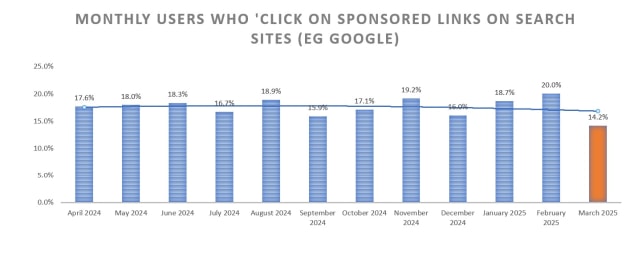
This shift is showing up in the data. According to Roy Morgan Single Source (April 2024 to March 2025), just 14.2% of users reported clicking on a sponsored search ad in March, a drop from 20% the month before and the lowest rate in a year.
“If that trend continues, AI Mode will only accelerate the behavioural change,” says Lagos.
From a media buying perspective, the change is in the numbers.
“Where we’d historically see a 70/30 budget split favouring traditional search over Google Ads' PMAX (Performance Max), we’re now consistently seeing that flipped in underperforming accounts,” says Lagos.
“PMAX is eating up spend - driven by platform pressure to automate everything, remove friction and ‘just trust the system’.
“But the cost of convenience is control. Keyword intent collapses. Brand terms compete with generics. Campaign insights blur. And when brand health starts to wobble, there's no obvious lever to pull or even worse, accountability.
“So, no, this isn’t the end of search. But it is the end of marketers being in the driver’s seat.”
Shai Luft, co-founder and COO at Bench Media, sees the old model, where you seek to rank in the top 10 blue links and earn “free” traffic, collapsing.
“AI answers summarise content on the SERP, meaning users increasingly don’t need to click,” says Luft.
Research conducted In 2024, shows up to 65% of Google desktop searches ended without a click, whereas for mobile it was up to 75%. Luft says this will only increase in 2025 and beyond.
“But Search isn’t dead yet,” Luft says.
“It’s evolving into something more conversational, contextual, and curated. We're heading into an era of answer engines rather than search engines where brand visibility must happen within the answer, not just beside it.”
David Einstein, co-founder of Orange Line, describes search as having more of an identity crisis than a death.
“Generative AI is the flashy new intern stealing the spotlight, but it still sneaks back to the search index to factcheck itself,” he says.
“Large language models (LLMs) are trained on a point in time—a giant static snapshot. To sound current they ping live search results.
“Translation: classic search is still the plumbing underneath the shiny new bathroom. Expect the interface to morph—from ten blue links to conversational snippets—but the underlying need to crawl, index, and rank information isn’t going anywhere just yet.”
Yes, AI search is resulting in fewer clicks for research-based queries.
“The reason is simple,” says Einstein. “For the top‑of‑funnel, AI overviews deliver quick answers, so research queries now generate impressions without the click‑through.
“The click simply shifts further down‑funnel when users are ready to compare prices, check specs, or sign up. Marketers need to optimise for being the source the AI trusts, not just the link people tap.”
Gipi Gopinath, head of experience & operations at Kinesso, says GEO (Generative Engine Optimisation) and AEO (Answer Engine Optimisation) are now important.
“Human behaviour is shifting as AI Search trust grows,” says Gopinath.
“However, the fundamentals are still the same: content is still ‘king’, search engines still value trusted expertise and a solid website experience remains the gold standard.
“If you’ve had a strong SEO plan for some time, you’re no doubt already made good progress with AI Search.
“However, things are evolving and it’s important to acknowledge this when we consider the future of SEO. The introduction of AI Search – both designated platforms such as Perplexity or sections like Google’s AI Overviews - is changing how people search and consume information.
“As humans, we often seek the path of least resistance and AI Search is saving the need to click to other sites in certain circumstances.”
One of Kinesso’s clients saw an 18% increase in AI Overview impressions, but a 10% reduction in clicks through to the site.
The announcements at Google’s I/O Conference last month around AI mode, including the ability to try on clothing and transact in search, indicate more and more of the user’s journey may be captured in this one “search” window.
“As consumer trust grows and hallucinations decline, it points to a continued trust in AI Search – particularly as its human-like conversational tone develops,” says Gopinath.
From a technical point of view, Google is moving beyond single query matching to a query fan-out technique, essentially looking for all sub-topics and questions that may be relevant before providing an answer.
Gopinath says that means it’s going beyond single keyword matches and considering the entire relevance in the moment – where that user is at in their search, what specifics they may need to know and even what follow up questions they may have.
Emma Davis, performance manager (search) at The Media Store, says the fundamentals of GEO (Generative Search Optimisation) are the same fundamentals of SEO.
Relevant content is still key. Three-quarters of the websites cited in Google’s AI Overview came from the top 12 results on the SERP (Search Engine Result Page) showing that websites with strong SEO also perform well across AI platforms.
Google has confirmed that it will integrate paid placement into its AI experience. Shopping ads are already appearing for some users in the AI Overview.
“While nothing has been confirmed yet, it is something we need to watch carefully as it is happening whether we are ready for it or not,” says Davis.
“AI has changed the way users search. Long-tail queries are becoming far more commonplace, so the use of broad match and the new keywords-less match types are going to become more important. Paid search are definitely moving away from keyword bidding to bidding on user intent.
“The measurement of AI Overviews in Google is a huge blind spot for marketers. AI Overviews are currently being lumped into organic search results but the behaviours of these users are completely different.
“Users no longer need to get to the website to get the information they need, which would impact impression, CTR and website metrics. We need a way to understand how users are interacting with the information used AI Overview.”
Nick Grinberg, head of strategy at Next&Co, describes the change in search as an “extreme evolution” as opposed to an end.
“The old search game was about visibility; the new one is about verifiability,” he says.
“Brands must now engineer their presence to be trustworthy enough to be summarised by AI.
“Some types of searches will be much more affected than others. For example, brands that rely on informational traffic for top-of-funnel discovery, are going to feel it first as AI provides better, easier answers for these types of ‘consensus answer’ queries.
“AI is unlocking a new style of complex, multi-criteria search behaviour. Instead of ‘best running shoes,’ we’re now seeing queries like ‘What’s the best running shoe for wide feet, under $200, that ships fast and looks good with jeans’?”
Hannah Mannion, SEO & website director, Yango, says AI-powered generative search tools are transforming search into an interactive, more conversational experience where users are looking for fast answers.
With Google’s market share dropping below 90% for the first time in 10 years, user search behaviours are shifting towards conversational interactions and engaging short-form content.
“Zero click answers from AI overviews mean businesses and marketers must pivot from keyword-based strategies and focusing on traditional metrics like clicks, towards creating AI-friendly content which focuses on intent, is well structured, shows expertise, and is designed to be integrated into AI-generated summaries and generative search engines,” says Mannion.
“Despite a decrease in clicks for queries returning an AI Overview, brands should focus on building authority and trust in their brand which can be gained from being sourced in these overviews.”
Tudor Stefanescu, head of owned channels at The Pistol, says SEO has seen many iterations over the years.
“Despite industry-defining moments when things looked grim, the persistence of human ingenuity found new solutions to retain organic search performance in Google,” says Stefanescu.
“I expect SEO to survive the way Google uses AI to keep users engaged in the search platform and off third-party websites.
“Let’s not forget that democratising machine learning and LLMs brings new tools marketers can use to optimise websites and feed the Google algorithm exactly what it needs.
“If anything, the recent developments open up the playing field for marketers to grow business visibility in ChatGPT and emerging LLMs.
Tommy Glover, head of SEO at Magic, says traditional SEO still matters because AI relies on high-quality, well-optimised content to generate answers.
“In many ways, search is becoming smarter and more user-focused, blending old and new approaches,” he says.
“AI is making marketing more efficient and targeted. Marketers now use AI tools to better understand user intent, automate research, and create content at scale.
“While the way people find information is shifting, brands that adapt and use AI to enhance their SEO and content strategies can reach audiences more effectively than ever before.”
Dave Mooney, the head of planning/strategy at BCM, says search has been for a long time the first channel on the plan.
The industry has put a premium on search’s ability to land their brands and products firmly in the crosshairs of their customers’ intent to buy.
And Google’s dominance has remained strong as the global authority in search with 93.5% global market share.
“However, there are signs of this dominance eroding with some sources reporting its market share has dipped below 90% for six of the last seven months for the first time in over a decade,” says Mooney.
“Although this may not seem like a huge dip, it’s an indication that things are beginning to change.
“ChatGPT is leading the charge in the AI revolution with 80% market share among AI tools, and processes roughly 37 million search-like prompts daily.
“Although this is a staggering number, it still is less than 1% of the volume Google sees with over 14 billion daily searches. So as much as things are beginning to change, it’s not time to rush out and sell your Google stocks just yet.”
He says the way to understand how AI is changing marketing begins with how AI is changing consumer behaviour.
“People interact with AI differently to how they interact with traditional search; therefore, it needs to be treated differently,” he says.
“AI search generally leads to longer, more exploratory search sessions averaging six minutes or more, compared to the average Google session which is just under two minutes. This is primarily because people are engaging with multi-turn conversational search through AI as opposed to single-query factual lookups.
“But when it comes to conversion behaviours, traditional reigns supreme. Traditional organic search still converts at a much higher rate compared to AI search. What this tells us is that people browse, consider and compare in AI but transact and buy in traditional search.”
Have something to say on this? Share your views in the comments section below. Or if you have a news story or tip-off, drop us a line at adnews@yaffa.com.au
Sign up to the AdNews newsletter, like us on Facebook or follow us on Twitter for breaking stories and campaigns throughout the day.