


Credit: Haseeb Jamil via Unsplash
M+C Saatchi is about to launch a new way to serve clients built around cultural influence, positioning it as a “different economical model for our industry”.
The global advertising group revealed some details when briefing market analysts on the results for the year to December.
M+C Saatchi reported a sharp fall in both revenue and profits in the year to December with the Australian business an outsized drag on the global business.
The company sees culture, in an increasingly fragmented world, as a way to link brand strategy and performance media.
Karen Boswell, brought in last year as global CEO, digital experience, performance & consulting, has developed a culture framework to build growth.
“Media spend alone no longer guarantees the growth that our clients need, and they are under pressure to prove return, not just activity,” she told the analysts in a presentation.
“Cultural power is our answer to that.”
She said the model will be available this year, backed by a pilot program, which clients have already signed up to.
The model connects consulting, PR, creative and performance media into a single integrated system, and M+C Saatchi claims no rival currently owns this.
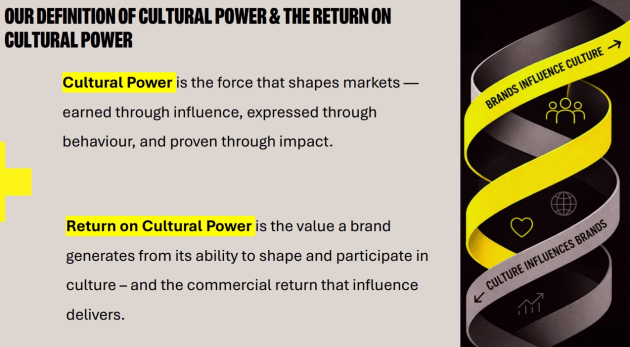
Boswell said the Oxford Said Business School has "validated" that the return on cultural power is the industry's first framework for measuring the commercial value a brand generates from its ability to shape and participate in culture.
“For decades, the marketing industry has been obsessed with measuring what we make, impressions, reach, share of voice, return on ad spend,” she said.
“We've all been building extraordinarily sophisticated systems that count things that are very easy to count, but we've been quietly ignoring the fact that the force really moving markets is culture, not as a metaphor, not as a mood board, but as a mechanism.
“It became really clear to us through conversations with our clients.
“They all expressed the same challenge to us. They can't define culture in a way that makes sense for them, nor can they work out how to measure the value of influencing it.
“So we have a very hard working definition of cultural power. It's the force that shapes markets, earned through influence, expressed through behaviour and proven through impact. In a world increasingly fragmented, culture is moving faster than ever.”
The model works upstream of performance media and downstream of brand strategy, connecting the two, M+C says, in a way that the industry has yet to do.
“That's the gap that we are solving for in very practical terms,” she said.
“It's how brands become more efficient at growth, how we lower the cost to acquire customers for them, and how we increase the ability to retain presence in influencing culture. “It's also how we operate and how we organise ourselves, because as well as culture moving very fast and being fragmented, our industry is also very fragmented. Consultancies will tend to define strategy.
“Agencies will tend to create campaigns, and media companies will tend to optimize spend. No one actually owns the end to end influence system we do and cultural power is therefore our framework for how we integrate on all capabilities into all the systems.”
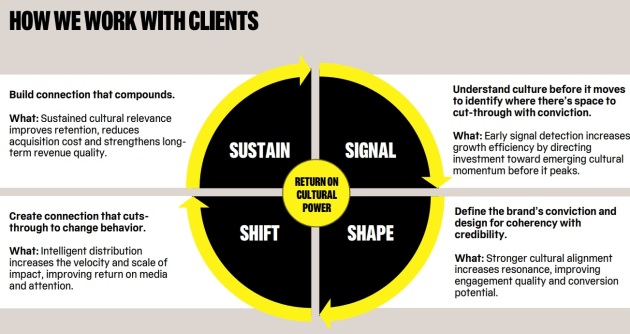
The first step in the process is taken by M+C’s consulting division, to identify demand ahead of the markets so that clients can invest just before the price premium of buying media, rather than in it or behind it.
“Then we move into shaping what a clear positioning, a clear presence in culture, looks like with and for our clients,” she said “And this is led by our consulting and PR and passions team working together, this means that marketing works harder and converts more efficiently in the moment, creating persistence within culture.
“Then we move into the shift phase, which is where our PR and passions team work with our agency team … looking to drive mass behavioural change at scale.
“Most agency groups would stop there, but because our performance media arm is built from conversion rate optimisation upwards … it means that we're able to close the loop and optimise continuously, not just for the campaign moment, but driving to the bottom line as well.”
Boswell gave the example of a client, a leading manufacturer of a GLP-1, a diabetes and obesity solution and a strong product in a fast growing category.
However, brands were competing on clinical data, risking becoming commoditised and defensible and increasingly reliant on media spend.
"It's the antithesis of what we're trying to do within cultural power,” she said.
“The opportunity was not to out-market the competition, it was to define how the category is understood and adopted.
“By building an emerging category, this company managed to shape meaning and capture that disproportionate value.
“It's where cultural power operates, not at the level of messaging, but at the level of market perception and behaviour.
“Taking our cultural power model, the first thing we look to do is look at that signal, identify the real driver of demand.
“And what we saw was that patients weren't buying a treatment, they were buying proof that change was possible.
“This helped us reframe the demand around the product and look to move from clinical outcome to personal transformation.
“This gave us the emotional and rational alignment, which meant that we could expand appeal beyond just the early adopters.
"That gives us a system to scale the narrative every touch point, from the healthcare professional through to the consumer, reinforced the same meaning, faster adoption, stronger attention, more efficient scaling everything from the small pieces of content to the large Super Bowl partnership and campaign that we did.
“Cultural power is not about visibility. It's about shaping those conditions under which demand for our clients grows.
“So in this case, we didn't just increase awareness, we changed how the category was understood and therefore how it scaled. Growth did not come from outspending the competitors. It came from shaping demand before it scaled.”
Slides from the presentation to analysts:
Have something to say on this? Share your views in the comments section below. Or if you have a news story or tip-off, drop us a line at adnews@yaffa.com.au
Sign up to the AdNews newsletter, like us on Facebook or follow us on Twitter for breaking stories and campaigns throughout the day.