


Credit: Shubham Dhage via Unsplash
Those working at Metigy, the AI marketing startup at one stage valued at $1 billion, realised only later, when the dream shattered, how they had been blind-sided, sucked into a confidence scheme.
The staff found themselves alongside other smart people on a worthwhile project, the then emerging technology of artificial intelligence.
Everything looked so solid, there were no questions. They concentrated on building a business, or at least their own small part of it. Apparently no one but the founder, David Fairfull, had a complete picture of the company.
Money, in the form of millions in investment dollars from reputable sources, kept flowing through the door, along with the press coverage spruiking market-leading AI use.
And then there were regular announcements of sales. There were few details given but why question that when there was other work to be done.
Fairfull, the founder who was also CEO, would enter the office on a wave of smiles, ushering in investors or potential partners, introducing staff members and adding something personal, a nod to their expertise.
A good con job works on several layers, including exhibiting a lot of confidence, hence the word “con”.
Other flavours include creating an air of legitimacy, nourishing believers in the spin, making sure there’s no objective scrutiny and, at the core, a touch of greed, or fear of missing out.
Fairfull had a strong run from founding in 2015 until the crashing end in 2022. He raised $39 million and was preparing another capital raising of $50 million before being found out. Along the way, Fairfull used millions of dollars of the funds raised to help finance a house on Sydney’s upmarket Lower North Shore and a luxury weekender at Kangaroo Valley.
Following an investigation by corporate regulator ASIC, Fairfull was jailed in June this year (2026) for nine years for lying to investors, falsifying financial statements and using his position as a director dishonestly.
The 58-year-old will be well into his 60s before he is released. He must first serve a non-parole period of five years and four months.
Metigy went into voluntary administration in August 2022, leaving its 75 staff without jobs.
The employees, who loved working there, had no idea the business was built on air.
Andrew Mara, leader on content and partnerships at Metigy, describes how he found himself in an upbeat startup working alongside people who knew what they were doing.
One of the major partnerships he put together was with the freelancing service Fiverr, to integrate that as a partnership within the platform.
The Metigy system would make a suggestion on what content was needed and then the creation of that, if a client didn’t have the expertise, would be outsourced to Fiverr.
“We just all assumed that he (Fairfull) was extremely wealthy,” Mara said. “He had been a partner at one of those big social companies, a co-founder or something.
“We all thought that there was a lot of money floating around.
“On the surface, it all looked great. We got the announcement of another injection of venture capital. That was just before I left.
“There was a partnership that we were seeking with Google. It was really humming. It was very positive and it seemed like it was a bright future.
“There's such a level of trust that you believe the communications that are coming through from the business are true. You don't, for a second, think that this whole thing is a sham.”
Another staffer, who didn’t want to be named, said the tens of millions of dollars invested was confidence building, knowing the investors must be doing their due diligence.
“It really was one of the best teams that I have worked with,” she said. “Everybody was talented.
“There's a need for the product and it felt very exciting as a startup, and that is obviously part of the deception because we all genuinely really enjoyed working there.
“There were no signs that the wheels were falling off. It seemed like you were onto a good thing.
“The whole AI thing was really interesting. Back then there was sort of a real air of mystery around it.
“And as it transpires it actually wasn't really AI at all. But you're trusting in the product that's being built, the problem that you're solving.”
The startup formed in 2015, with cash from Fairfull and from We Are Social, a socially-led creative agency where Fairfull had been a managing partner.
Then came private equity firm Cygnet Capital and CP Ventures. Both added an air of legitimacy.
The investment came on the back of bank statements which later were found to have been doctored by Fairfull. This was a simple matter of using that creative tool Adobe to change PDFs.
A planned capital raise in 2020 was interrupted by the declaration of the covid pandemic. But not for long.
The capital raise was then conducted via Zoom. Fairfull then told AdNews that Cygnet Capital offered to help with contacts for significant Australian investors.
“We worked our way through that discussion for a couple of months, all on Zoom, the entire process,” Fairfull then said.
“All the due diligence on Zoom, which I wouldn't have thought you could do, because you want to be able to build rapport with people.
“As it turned out, we were trying to raise $10 million but we got expressions of interest for $22 million, and we took $20 million. A pretty good result and I've only met one of those investors in person since then.”
The funding round attracted Regal Funds Management, OC Funds, Five Venture Capital and Thorney, which added to early-stage investments from Cygnet, CP Ventures and We Are Social.
At CP Ventures, co-founder and managing partner Emlyn Scott and fellow managing partner Chris Sang put in their own money as well as $1.3 million from their ventures fund, then representing about 13% of the pool. The value of this investment was at one stage calculated at $60 million.
The investors in the CP Ventures Fund were about 50 individuals, mostly people saving for retirement.
“We introduced David to a further five to ten investors who committed millions of dollars of their own capital,” according to Emlyn Scot at CP Ventures in a victim impact statement to the Federal Court.
Ben McCallum at Regal Funds Management told AdNews in April 2021 that the numbers for Metigy showed an in-person meeting wasn’t needed.
“Month on month, it just continued to grow and grow,” McCallum then said. “Over a period of time, they continued to outperform our expectations and their own internal budgets, which meant that it was growing at an extremely rapid pace.
“And they managed to keep that growth at the same rate, despite the fact that they were getting bigger and bigger.”
McCallum advised Metigy to raise more money earlier. He told Metigy: "Look, you're better off raising more now to make sure that you're capturing the best of the opportunity that's ahead of you. You've got the balance sheet to go and acquire the talent, the employees, that you need to.
“There is a talent war out there and making sure you've got the best people is important, and the best people want to know that any business that they're about to join is very well-funded, and it's got the capacity to grow for years on years without needing to raise money. And so we thought there were a whole bunch of benefits to them raising more money.”
The investors were shown numbers that worked for them.
An early pitch deck showed Metigy with 2018 financial year revenue of $1.2 million. (The actual number was no more than $11,859.28).
In 2020, Fairfull gave Cygnet updated financial information representing that Metigy’s revenue for May was $750,000. The true figure was $1,083.16.
In February 2021, investors received a quarterly update putting Metigy’s “Total net revenue” for July to December 2020 as $6,160,567.22.(It was really $12,522.27).
The same update put net revenue for January 2021 at $1,512,000. (It was $2,277.70).
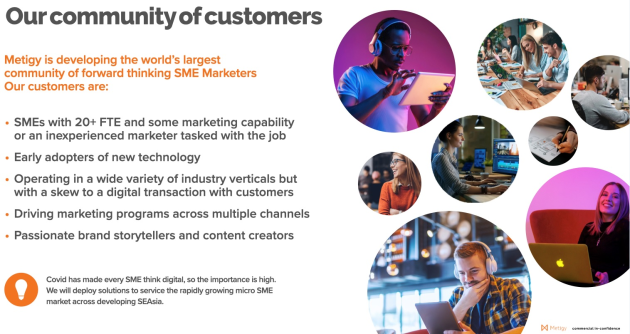
The revenue curve upwards was seductive as was the target market. The idea behind Metigy followed many entrepreneurs before who saw a deep well of opportunity in SMEs (small to medium enterprises with staff of 20 or so).
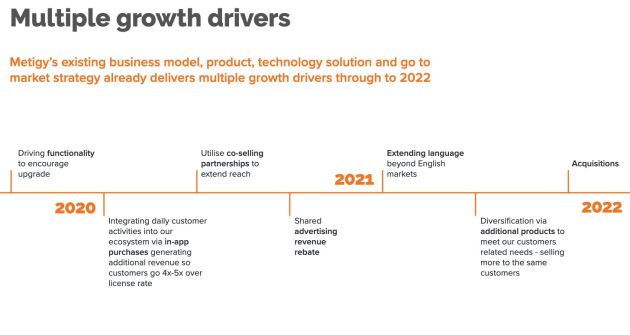
McCallum at Regal Funds spoke of multiple avenues for bringing in revenue apart from the core product.
“The content curation part is one thing that we found really exciting. They've obviously got a strong relationship with some of the providers of images and videos. And when Metigy helps the SME pick what image they should be using, and instead of paying the retail price that the customer would usually pay, they get a better rate through Metigy and Metigy takes a small fee off of that.
“And the most attractive part about that is the fact that the customer is getting a better deal as well, so they're going to want to keep using it more as well. They're actually paying less for a better service and everyone wins."
In a pitch deck used by Metigy for potential investors, the startup claimed to be building the "world's largest” community of “forward thinking” SMEs.
“But we had no visibility into the system,” Mara said. “We didn't know what the pipeline really was. We were kept at arm's length. And with the tech rollout, we weren't really seeing under the hood.
“That's when people started asking questions.”
Everyone was surprised when the company went into administration. “It was a big shock, to be honest, but at the same time everything made sense once that came out.”
Within the company, there had been a lot of talk about sales being made but no specifics.
“A lot of deals were being spoken about, but at the end of the day, the technology never worked,” Mara said.
“We had questions internally before I left about what was going on. The tech just didn't seem to be there.”
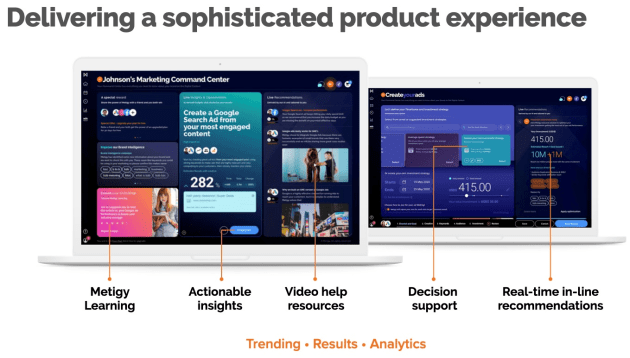
The technology was meant to be a social media management tool. The promise was it would scan everything, look for trends, a client’s industry, help develop content, suggest what kind of content should be posted and when and where it should be posted.
And there was meant to be a big image bank with suggested images that will perform based on what competitors were doing right.
“I was trying to promote the platform and work with partners to get adoption,” Mara said.
“But at one stage I realised that it couldn't be AI. We thought: This just isn't working, it isn't doing anything for us.
“It was one of those questions where we all were asking each other: How is this any better than any of the other social media management tools out there? Because it's really not, it's not doing what it's saying it's meant to do.”
An anonymous former staffer, who stayed to the end, said there was a need for the product.
“It felt very exciting as a startup and that is obviously part of the deception because we all genuinely really enjoyed working there,” she said.
“When you know there's no signs that the wheels are falling off, it seemed like we were onto a good thing.
“Back then there was sort of a real air of mystery around the whole AI thing but as it transpires it actually wasn't really AI at all. But then we were trusting in the product that was being built, the problem that we were solving.”
Towards the end, just before the crash, one staffer noted a reluctance to do some public relations work.
There was an instruction: We don't really want to do that. There's no time or capacity for it.
“Looking back on it, he was supposedly busy doing fundraising,” the staffer said. “Actually what he was busy doing was trying to save the business, or trying to save his own situation.
“There were a couple of signs, but I wouldn't say that there was anything really massively alarming, you know, really, until we weren't paid on a Friday,
“He (Fairfull) probably knew that the wheels were about to come off but we really had no idea that he was deceiving people to such a degree,” the staffer said.
“He always came across very, very friendly, very personable, quite charismatic.
“I wasn't somebody that reported directly to him but for the people who were it was a real shock. I think that there was a real feeling of: This actually doesn't align with the person that we see in the office. Maybe that is part and parcel of being a good fraudster.”
After not seeing pay in their bank accounts on a Friday, the staff had a meeting with the administrators on Monday.
“It turns out that he (Fairfull) knew that the company was going under as early as June but let us work for the whole of July, knowing that we couldn't be paid,” the staffer said.
“He (Fairfull) was also on that call and he talked about his health. I think that was one of the things that he'd used, or he tried to use, in his defense.
“That feels like a real betrayal. As an employee, you're holding up your end of the bargain and you go to work in good faith expecting to be paid at the end of the month.
“A real sense of deception, particularly when you're working for a startup where everybody's invested in it, putting in the extra hours, a bit of your heart and soul.
“I think it's taken people a long time to recover because you think to yourself: ‘We are terrible judges of character.’
“But hold on, there were investors who are well used to doing their due diligence and crossing the Ts and dotting the Is.
“And there were 75 of us that worked for him, so that doesn't come down to individual judgment. This is somebody carrying out deception on a big scale.”
The ATO was owed millions. It turned out the PAYG payment to the ATO had not been paid.
Staff had to prove to the ATO that they had not benefited as employees when doing tax returns.
“I think the only thing that I've really learned from it is that I now always look to see if there's a board of directors,” a staffer said.
“That's something that I have learned, because there wasn't. I don't think there was a board of directors, so I look into that governance side of things a lot more, you know. It's just one of those things.”
Fairfull was, in the end, exposed by a manager who discovered the deception and contacted investors, who then went to his house to confront him. Fairfull admitted it immediately.
And he put in a guilty plea when charged. The Federal Court was told Fairfull had been “convinced that all investors would be reimbursed their investments down the track” when the startup came good.
His lawyers argued that Fairfull’s offending should not be characterised as archetypal predatory corporate criminality motivated by personal greed.
“The offending occurred in the context of a genuine operating technology start-up under escalating commercial pressure, and reflected progressively entrenched concealment, distorted decision-making and deteriorating psychological functioning on the part of the offender rather than inherently predatory conduct driven by anti-social attitudes or purely by greed,” they said in a submission to the Federal Court.
And they argued that anxiety and depression materially contributed to the commission of his offences, such as to lessen his moral culpability.
“The offender's conduct was directed toward maintaining the viability of the business and continuing development of what he believed to be a commercially valuable product which would ultimately generate profits for those who invested, rather than the systematic extraction of investor funds for personal enrichment throughout the offending period,” his lawyers said.
The judge didn’t agree. “He engaged in multiple acts of dishonesty using his position of trust and control, which included forging banking documentation to induce others to invest and provide capital for his business,” said Justice Wendy Abraham.
“His deception escalated over time. He took the approach of the ends justified the means; it enabled the companies to continue working towards the product being produced, and its success from which he would benefit.
“Knowing the financial circumstances of the companies, he nonetheless provided to himself a substantial personal benefit of $7.7 million through the director loan to acquire residential luxury properties.”
The office of the Commonwealth Director of Public Prosecutions submitted that Fairfull’s hope of eventual success does not transform years of “deliberate forgery and false statements” into something less than what they are.
“Offences of this nature undermine the integrity of Australia’s financial markets and system of corporate regulation,” the submission said.
“That damage is the same whether or not the dishonest founder convinces himself that the product will eventually save him.
“The offender’s self-serving belief that investors would in time recover their money is, in any event, contradicted by his own conduct ... by November 2021 the offender was diverting $7.7 million of investor funds to acquire personal real estate.”
A staffer had a message for Fairfull: “You know, you did a very stupid thing. I am glad there were consequences to it. You can't run a company like that. You have a responsibility and a duty of care to the people that you employ and the people that invest in your business. You fully abused that.”
Was the Metigy AI really a working platform? “There was nothing AI about it,” CFO Stephen Robinson told the Federal Court. The AI was in reality recommendations for ad placement based on client input. In the early days this was run from Bangladesh. However, some said that late in the history of Metigy, experts were hired in Australia to work on development of a platform.
Slides from the Metigy pitch (when it was THE next big thing):

Have something to say on this? Share your views in the comments section below. Or if you have a news story or tip-off, drop us a line at adnews@yaffa.com.au
Sign up to the AdNews newsletter, like us on Facebook or follow us on Twitter for breaking stories and campaigns throughout the day.