


Australian media companies are reporting referral traffic falls of up to 70% as AI-powered search overviews stop readers before they reach a news site.
Duncan Stewart, co-author of Deloitte's annual Technology, Media and Telecommunications predictions, said he had spoken directly with three Australian media companies which reported a collapse in click-through traffic.
"Referral traffic is down 50% to 70%. This is an existential threat," Stewart said.
"Bluntly, how do we fund news when people can't discover the news and aren't clicking through on it."
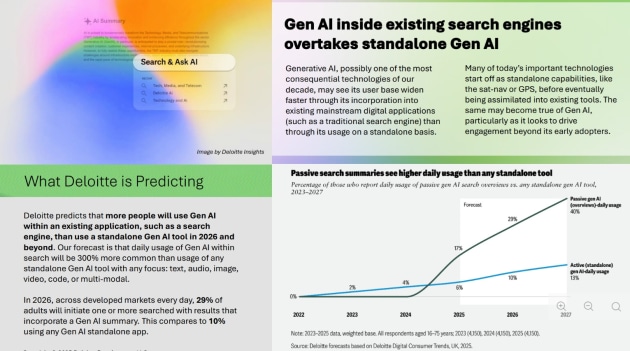
Deloitte estimates 25% of Australians who engage with AI search summaries stop there — reading the overview and going no further. On current trajectories, 50% of Australians will be engaging with AI search results daily by 2027.
The phenomenon, known as zero-click search, is accelerating as AI overviews become standard in Google search results.
Stewart said the established playbook — built around search engine optimisation — no longer applies.
"That's shifting in an AI world. It is less, or maybe not even about that at all," he said.
The disruption extends beyond traffic. Advertisers and agencies are also having to rethink how discovery works when users no longer follow the traditional path of query, click, and page view.
"How do I as an advertiser, how do I as a marketing firm and an ad agency, how do I build a program? How do I think about this entire process when people are not clicking on 10 blue links the way they used to?" Stewart said.
Peter Corbett, the TMT report co-author and Telco, Media & Entertainment Partner, Deloitte Australia said the broader media landscape reflects a market under sustained pressure.
Subscription numbers are rising — averaging 3.7 per household — and spend is up to around $76 per household on digital subscriptions.
But advertising dollars continue to migrate to social video and YouTube, pulling from display and traditional search.
"YouTube continues to grow. Social video is the number one growing category in advertising," Corbett said.
For traditional publishers and free-to-air broadcasters, the squeeze is coming from multiple directions.
Stewart said that outside the zero-click problem, the 2026 media landscape would broadly resemble 2024 — low margin, slow revenue growth, cost cutting doing some of the heavy lifting. But the digital giants are a different story entirely.
"Revenue growth is accelerating. Profit margins are rising. The rich become richer," he said.
Against that backdrop, media companies are experimenting with new formats.
Channel Nine has launched Flex, a micro-drama series targeting younger audiences, as part of a broader industry push into short-form vertical video.
Deloitte projects 8% of Australians aged 18 to 34 will regularly engage with micro-dramas by 2028.
Video podcasting, or vodcasting, is emerging as the fastest-growing segment in digital audio, with nearly 70% of ad buyers planning to increase podcast investment and three-quarters having considered vodcast placement for the first time.
And by 2027, one in five Australian adults will have seen a deepfake of someone they know, adding regulatory pressure to an already complex environment.
Stewart said the industry knows something has to change but has not yet found the answer.
"Everybody agrees, we just don't know. Having 5 million people with smartphones is not a substitute for an investigative reporter. They are not the same thing."

Have something to say on this? Share your views in the comments section below. Or if you have a news story or tip-off, drop us a line at adnews@yaffa.com.au
Sign up to the AdNews newsletter, like us on Facebook or follow us on Twitter for breaking stories and campaigns throughout the day.