


Credit: Amanda Dalbjorn via Unsplash
Australians are spending more on media and entertainment subscriptions but less time on screens and scrolling.
This continuing a shift towards more conscious consumption is revealed in Deloitte’s 14th annual Media & Entertainment Consumer Insights report, which surveyed more than 2,000 Australians.
“What’s driving Australians to switch off or put the phone down isn’t quite clear,” said Peter Corbett, lead partner at Deloitte Australia Telecommunications, Media and Technology.
“It could be a mix of factors, including - after a peak in screen time during COVID, consumers our choosing more 'in person' entertainment forms, or changing preferences for the content mix offered across media categories.”
The study found monthly average digital entertainment spending rose 24% to $78 from $63 between 2024–2025, as Australians added more subscriptions and platforms successfully pushed through price increases.
Households now hold an average of 3.7 subscriptions, up from 3.3 last year and 2.3 in 2021.
Gen Z households pay $101 monthly for their subscriptions – the highest number to date - with 98% having at least one paid subscription, compared to 90% across all households.
Subscription video on demand (SVOD) streaming platforms and music services are driving growth in subscription volumes and remain the leading categories with households holding an average 2.3 paid SVOD subscriptions and 0.7 paid music subscriptions.
More than a third (36%) say their subscription spending is over budget and 78% are worried about the total cost of subscriptions.
Despite subscriptions and spending increasing, Australians are increasingly switching off and are spending less time engaging media and entertainment for a second year in a row, illustrating an overall shift to more conscious consumption.
Australians spent an average of 42 hours and 45 minutes every week engaging with media and entertainment in 2025, compared to 44 hours and 15 minutes in 2024, a fall of 3.4%.
This year’s decline in consumption time is smaller than the 10% drop between 2023 and 2024 and was driven by falling rates of engagement with news/magazines (-26%), social media (-16%) and video (-13%).
Audio is the only media category with significant growth in consumption time (+34%), with music platforms doing most of the heavy lifting. Audio now accounts for 29% of total digital entertainment consumption.
“To adopt Gen Z parlance, Australians are ‘learning to touch grass’ or disconnect from technology,” said Corbett.
“Time spent engaging with media and entertainment has fallen for a second year in a row as Australians become increasingly choosy about what they consume.
“Audio is the noticeable exception, with younger Australians spending more time streaming music and podcasts while older Australians still prefer the radio.”
Average social media consumption has fallen by a full hour every week, with only mature-aged Australians recording an increase in use.
Australians spend an average of 5 hours and 20 minutes on social media every week, a 16% drop from 2024.
Boomers recorded the sharpest drop (27%) while Gen Z and Millennial usage both dropped by 13%.
Among parents, 64% are concerned about social media’s impact on children and half use parental controls to limit what their children can access online, with trust in existing regulations low.
The fall in social media comes as platforms prepare for the federal government’s Online Safety Amendment (Social Media Minimum Age) Bill in December.
Concerns over the effect social media has on children means most Australians back social media age restrictions, but questions remain on enforcement and age thresholds.
“The decline in average social media use has eclipsed the broader media and entertainment consumption decline, although the extent of this decline is inconsistent across demographics as different age groups use social media in different ways for different purposes,” Corbett said.
“What is clear is that parents want stronger rules and regulations governing children’s access to social media as well as greater support from government and industry in the form of education, accessible tools and trustworthy safeguards.
“That being said, digital platforms are neck-and-neck with established media when it comes to their perceived positive impacts on society. But when it comes to news consumption, Australians trust domestic publishers the most: more than three in four consumers consider national and regional Australian news publishers moderately or very trustworthy.”
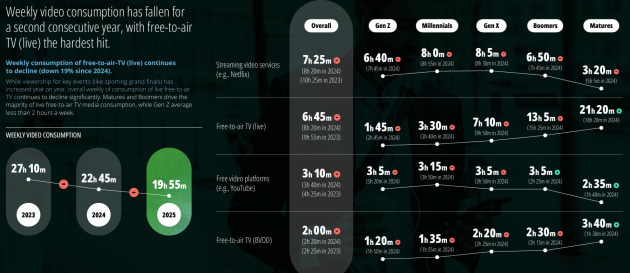
Weekly video consumption fell 19%, with free-to-air TV the hardest hit.
While viewership for key events such as sport grand finals has increased, overall weekly consumption of live free-to-air TV continues to decline significantly.
Matures and Boomers drive the majority of live free-to-air TV media consumption, while Gen Z average less than two hours a week.
Free-to-air TV is seen as the most influential type of advertising, but its power is threatened by declining viewership.
The degree to which Australians engage with the ads varies by device, generation and gender.
Gen Z, Millennials and Gen X are more willing to engage with advertisements on their smartphones than on TV, while the opposite is true for Boomers and Matures.
These device-based preferences reflect the types of advertising that consumers perceive to be the most influential on buying decisions. Ads on free-to-air rank highest.

Have something to say on this? Share your views in the comments section below. Or if you have a news story or tip-off, drop us a line at adnews@yaffa.com.au
Sign up to the AdNews newsletter, like us on Facebook or follow us on Twitter for breaking stories and campaigns throughout the day.