


Adding digital billboards to Nine Entertainment’s advertising offering, including television and publishing, makes a good home for some of the cash it extracted from the sale of classifieds site Domain, according to analysts.
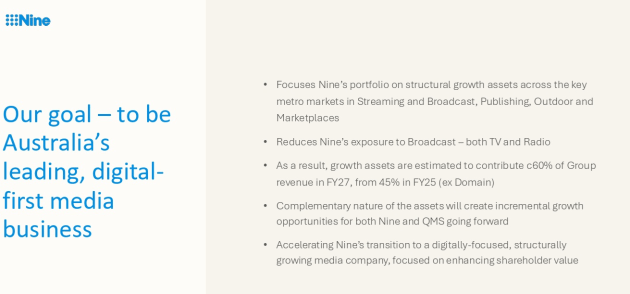
Financial services firm Barrenjoey, in a note to clients, called the move “strategically sound,” a repositioning to outdoor and the growth that comes with that media, lifting digital revenue to 60% from 45%.
And the market gave the deal to buy QMS a tick. Nine shares closed 5% higher at $1.145 on Friday.
Nine CEO Matt Stanton called the media group’s move an opportunity to drive an “unparalleled” advertising proposition, and content, from “Sofa to Street”.
The combination of outdoor, streaming and broadcast, and publishing delivers “reach, sustained frequency and impact,” enabling brands to engage audiences at home, in the city and in moments of high consideration.
Campaigns linking outdoor to television, in cross-media or integrated advertising, have been found to reinforce commercial messaging.
But was selling radio, including premium assets 2GB in Sydney and 3AW in Melbourne, a good play?
Over at competitor Seven and SCA, the new combined group, Southern Cross Media, is betting on the combination of radio and television.
Senior media agency executive Mark Coad said Nine would be a stronger player if it added QMS and retained radio.
“This would have given them a large(r) media company that encompasses visual/screens, print/publishing, OOH and audio...a full suite to cover multiple solutions for advertisers,” he said.
“I'm sure they have a very sound reason for dropping radio, but it's not apparent to me. I doubt they needed the cash given the relative size of the QMS deal.”
Virginia Hyland, CEO and commercial partner at Squad M&A, said the acquisition of QMS isn’t about buying billboards, it’s about buying cultural visibility.
“In a market where audiences scroll past ads and skip content at will, digital out-of-home remains one of the last truly unavoidable channels,” she said.
“For Nine, the real strategic value is using outdoor screens not just to sell media, but to promote its own shows, streaming launches and live events in places where attention still exists — streets, transport hubs and entertainment precincts.
“That matters because younger audiences aren’t listening to radio or watching linear TV in meaningful numbers, but they are out in the world, highly visual and highly influenced by what feels current and present in their daily lives.
“Just as important is what Nine walked away from. Exiting traditional radio and doubling down on DOOH is a clear-eyed acknowledgement that relevance now comes from being seen, not scheduled.
“This is capital being redirected from formats with ageing audiences into platforms that help keep the brand visible, modern and culturally connected.
“The upside for advertisers — and for Nine itself — will depend on execution. Outdoor can’t sit in a silo.
“If these screens are fully integrated into Nine’s content engine, data systems and cross-platform sales model, they become a powerful tool to drive streaming, amplify IP and attract the next generation of viewers. If not, it’s just expensive real estate. But done well, this move positions Nine as a media business building for the next decade, not defending the last one."
Ben Willee, executive director, media and data, at Spinach, said there’s no doubt that TV and outdoor are a natural fit.
“Strategically there is enormous benefit for Nine to be able to promote their TV shows using outdoor,” he said.
“Both mediums live proudly at the top of the funnel where brands are built.
“The hard part is not the strategy, it’s the sales force. The trick for Nine Entertainment and QMS Media will be grabbing more share without turning the whole thing into a bureaucratic car park where salespeople spend more time in meetings and spreadsheets than actually selling.
“The real question is what is the Laundy family (the buyers of Nine premium radio assets) like as media owners?”
Media analyst Steve Allen at Pearman said the deals pretty much deliver on what CEO Max Stanton and his board considered was the strategic next chapter.
“They shed some dwindling assets (due in part to an inability to come to grips with their strategic direction and future), and picked up a major player in an expanding and popular marketplace, most of their major customers already use (as does the media sector),” Allen said.
“Profit margin is also better than that which they shed, and that which these new assets join. With upside. This is a solid deal.”
Brian Han, director of Morningstar, poses the question: Will Nine have a better proposition for advertisers by adding outdoor media and dropping radio?
“Also, can the different division people work together to deliver that proposition?” he told AdNews.
“History has shown tv people are different to newspaper people are different to outdoor people etc.”
A slide from Nine's announcement:
Have something to say on this? Share your views in the comments section below. Or if you have a news story or tip-off, drop us a line at adnews@yaffa.com.au
Sign up to the AdNews newsletter, like us on Facebook or follow us on Twitter for breaking stories and campaigns throughout the day.